
In the industrial and logistics sectors, waste management is traditionally viewed as a sunk cost—a necessary evil on the monthly balance sheet. Business owners expect to pay hefty fees to have dumpsters hauled away. However, upgrading your facility with an industrial baler fundamentally shifts this dynamic.
Instead of paying to throw away loose cardboard, plastics, and aluminum, a baler transforms your waste into a standardized, sellable commodity. For most mid-to-large scale facilities, a high-quality industrial baler provides one of the fastest Returns on Investment (ROI) of any warehouse equipment. Here is a breakdown of how these machines pay for themselves, often within the first 12 to 18 months.
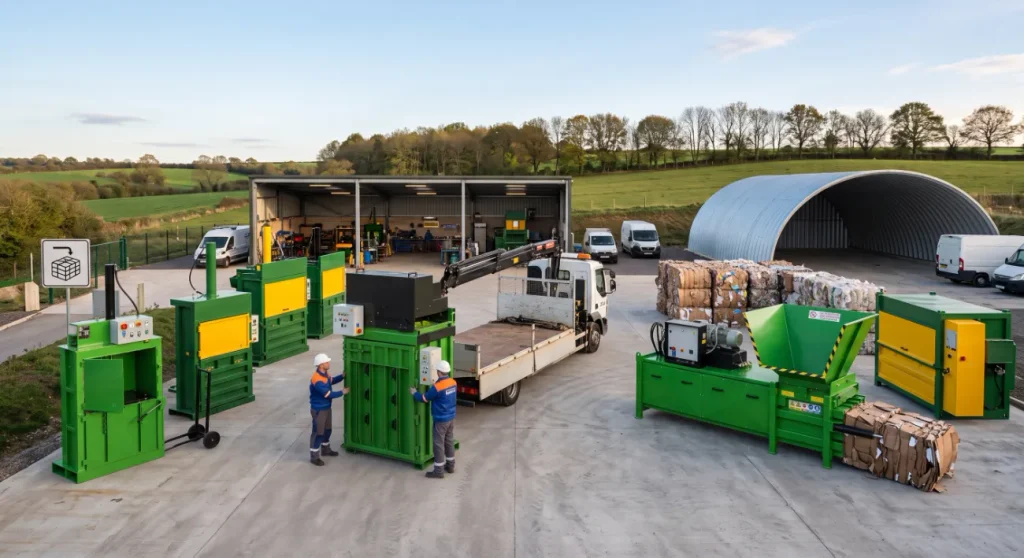
The Three Pillars of Baler ROI
Calculating your return on investment requires looking at three distinct financial impacts: avoided costs, new revenue, and operational efficiency.
1. Slashing Waste Hauling Fees (Avoided Costs)
Waste management companies typically charge by the “pull” (each time they empty your dumpster), not strictly by the weight of the trash. When you throw loose, uncrushed cardboard boxes or EPS (styrofoam) into a dumpster, you are essentially paying premium transport rates to haul away empty air.
By compacting your waste with a vertical or horizontal baler, you can achieve a compaction ratio of up to 10:1 (and up to 50:1 for EPS). If your facility previously required four dumpster pickups per week, baling could reduce that requirement to just one pickup every few weeks. This immediate, drastic reduction in hauling fees is the first major contributor to your ROI.
2. Generating Direct Revenue (Selling Bales)
This is where waste becomes a goldmine. Loose cardboard mixed with general warehouse trash has negative value. However, when sorted and compressed into dense, mill-size bales (typically 400 kg to 500 kg), Old Corrugated Containers (OCC) become a highly sought-after raw material.
Recycling mills and brokers actively purchase clean, baled cardboard, shrink wrap (LDPE), and PET plastics. Instead of receiving an invoice for waste removal at the end of the month, your facility receives a check from a recycling broker. The current market rate for baled OCC fluctuates, but it consistently provides a lucrative secondary revenue stream for distribution centers and manufacturing plants.
3. Reclaiming Labor and Floor Space (Operational Efficiency)
Time is money, and space is premium real estate.
- Labor: Without a baler, employees waste countless hours manually breaking down boxes with utility knives. A baler automates this process. The operator simply throws whole boxes into the hopper and presses a button, freeing up labor for revenue-generating tasks like picking and packing.
- Space: Piles of loose waste consume valuable square footage that should be used for inventory. A baler consolidates this footprint, instantly reclaiming warehouse space.
A Simplified ROI Calculation
To estimate how quickly a machine from Bartontech will pay for itself, use this simplified formula:
Total Cost of Investment (Machine + Installation + Training) Divided By (Monthly Hauling Savings + Monthly Bale Revenue + Monthly Labor Savings)
Example:
- Baler Cost: €15,000
- Hauling Savings: €800/month
- Bale Revenue: €500/month
- Labor Savings: €200/month
- Total Monthly Benefit: €1,500
ROI Timeline: €15,000 / €1,500 = 10 Months.
In less than a year, the machine is fully paid off. From month 11 onward, that €1,500 is pure operational profit added directly to your bottom line.
Conclusion
Viewing an industrial baler merely as a “trash compactor” ignores its true financial potential. Whether you choose a compact vertical press for a retail backroom or a fully automated horizontal channel baler for a massive fulfillment center, the financial math remains the same. By turning an expensive logistical headache into a streamlined revenue generator, an industrial baler is one of the smartest investments a modern business can make.